Shrimp Scampi: A First-Time Fiasco (With Extra Butter)
This story comes from Mario Flores who was born in Albuquerque New Mexico, where as the youngest child he didn’t really have the need to cook. Someone was always cooking or the older children were buying the fast food they were never allowed to have as children.
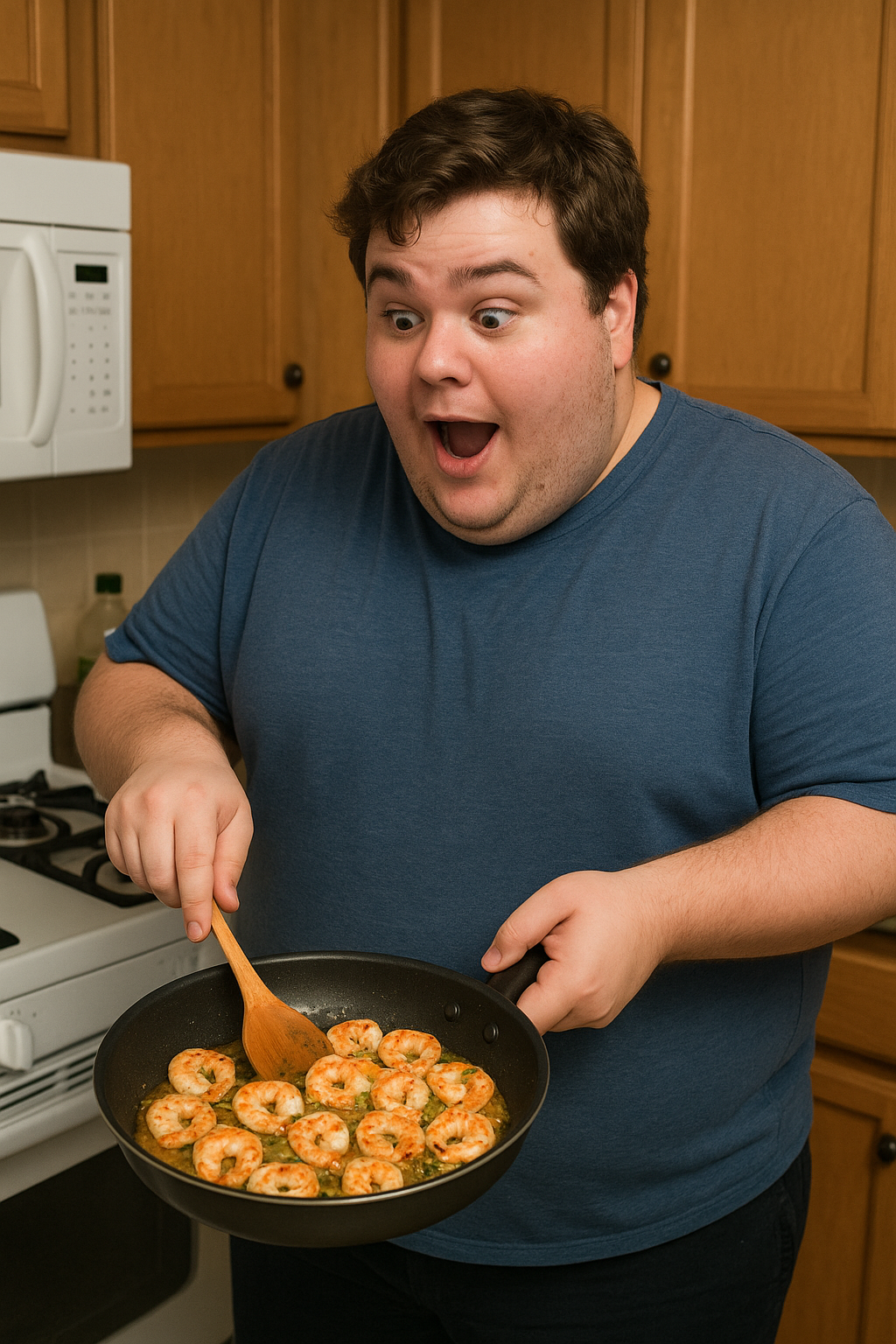
Something New
Garlic, butter, and the bravery to try.
Real cooking had always been background noise in Mario’s life; the clatter of pans, the scent of chile or simmering beans, the effortless way his mom or siblings moved around the kitchen. It felt like something that happened around him, never something he needed to step into himself. But now, standing over a pan of sizzling shrimp scampi, he felt an unexpected surge of excitement tangled with just a touch of panic. What started as a simple recipe suddenly feels like a quiet rite of passage his first deliberate step into doing something entirely on his own.
Analysis: Excited, Overwhelmed, and Triumphant
His experience is not just a personal narrative; it echoes transformations in domestic labor, food culture, immigration-driven culinary shifts, and changing American attitudes toward cooking and identity. In many ways, Mario’s journey mirrors broader historical developments in how Americans learn to cook, what they cook, and how they understand the value of home-prepared food. First, Mario’s late introduction to cooking highlights a generational shift. In mid-20th-century America, cooking was taught early and often, usually in the home and reinforced by gendered expectations. Household food preparation was largely women’s work, and many young people grew up with daily exposure to scratch cooking. However, beginning in the 1970s and accelerating through the 1990s and 2000s, two changes reshaped this landscape: the rise of fast food and convenience products, and the increase in dual-income households. For many families, especially busy, working-class households, cooking became less of a daily ritual and more of an occasional task. Mario’s childhood in a home where food appeared “around him” but was never something he needed to learn is historically typical of younger generations raised amid abundant takeout, packaged foods, and quick-service restaurants. His reliance on siblings buying forbidden fast food is emblematic of a broader national trend: the normalization of eating out and the decreasing transmission of cooking knowledge within families.
Second, the dish he chooses shrimp scampi, reveals how American cuisine itself is a medley of immigrant influences. Scampi has Italian roots, yet the American version, built around shrimp, butter, garlic, parsley, and pasta, evolved primarily in Italian-American communities in the twentieth century. Its modern status as a “beginner recipe” on YouTube or cooking websites demonstrates how ethnic dishes have been mainstreamed into the American palate. What was once an immigrant adaptation is now a go-to entry point for novice cooks. His struggle with fresh garlic, pasta timing, and seasoning shows how American cuisine has become both globally influenced and increasingly technique-driven: even “simple” dishes require basic culinary literacy that not all young adults possess.
His use of online recipes and cooking videos represents another major historical shift. Historically, Americans learned to cook from family members, community cookbooks, or home economics classes. Today, as home ec has vanished from most schools and as family cooking knowledge has weakened, digital media has become the primary teacher. His evolving relationship with seasoning further reflects American culinary history. Traditional Anglo-American cooking, for much of the 19th and early 20th centuries, was notoriously under-seasoned. Over time, immigration, globalization, and the influence of regional cuisines especially Southwestern, Mexican, and Asian, broadened the national palate.
Moreover, his discovery of frozen vegetables speaks to a long-standing innovation in American cuisine. Since the advent of flash-freezing in the 1930s, frozen vegetables have symbolized convenience, affordability, and reduced waste. Values that align with modern cooking habits, especially for young adults. Mario’s appreciation for their practicality places him within a historical lineage of cooks who have embraced food technology as a solution to time and budget constraints.
Finally, what ties his story most closely to American culinary history is his emotional response: pride, independence, and self-discovery through cooking. Throughout U.S. history, food has served not only nutritional needs but also social, cultural, and personal ones. In the 21st century, as cooking shifts from obligation to choice, many Americans (like Mario) find that learning to cook becomes a marker of adulthood, identity formation, and self-reliance. His shrimp scampi is more than a meal; it is a modern rite of passage grounded in the evolving story of American foodways.