Public School Lunch
This story comes from Jace, who began his schooling journey at a charter school without a lunch program. In 3rd grade, he moved to New Mexico, where everyone got free school lunch.
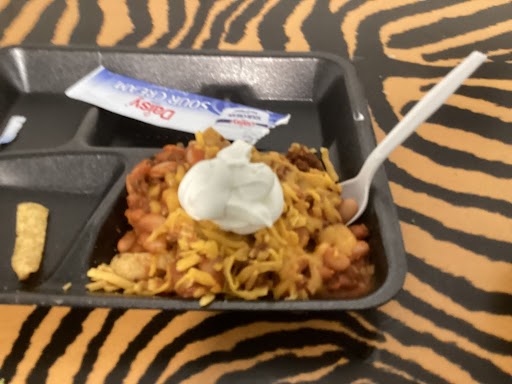
Frito Pie
Trying new things
For the first 4 years of schooling, Jace’s parents packed him lunch. Sometimes pizza rolls and other times leftovers from dinner. He always knew what to expect. Moving to a new school was scary enough, but the thought that the school lunch (and breakfast) was unpredictable was a new challenge. Even reading the menu was a gamble because the offering did not always match what was listed. The idea of this was exciting, and even if he didn’t eat lunch, he had snacks at home.
Analysis: food preferences, cultural adaptation, and the quality of public school meal programs
Jace’s experience reveals how food can serve as a marker of your personal identity and the community you belong to. His enthusiastic adoption of New Mexican cuisine—particularly red chile dishes—demonstrates how children negotiate new cultural identities through eating. His preference for the “new” Frito pies that are “spicy,” and “savory” suggests he is not just tolerating regional food but actively claiming it as his own. The fact that he now compares everything favorably to New Mexican versions indicates he is developing a New Mexican food identity, even as a relative newcomer.
Recognizing that “the first time you had red chile enchiladas was here” marks a before-and-after moment in the child’s culinary life, treating geographic relocation as a kind of food initiation ritual. This reflects a broader American pattern where regional food identities remain strong despite national homogenization, and where “becoming local” involves adopting local eating practices. The phrase “everybody got free school lunch” is loaded with meaning. Universal free lunch eliminates the stigma historically attached to “free lunch kids”. This placed everyone on the same level as being able to enjoy lunch without the concerns of what other students thought.
However, this also reveals class assumptions. Packed lunches from home always seen as higher quality. This is countered by the interesting new fruits and vegetables that are offered by the school. Jace’s comment that school lunches were “not as good as lunch as you packed me, though” reinforces familial food labor as the gold standard while also posing school lunch as being poor quality. This also reflects American anxiety about the quality-of-care children receive outside the home, particularly in a public-school setting. There are items worthy of seeking out and eating, such as the rolls that appear to be homemade.
The argument of what is authentic is one that we have touched on during our class. Does New Mexican food in mass produced setting remain true to the roots? For Jace there is no contradiction. For him, school Frito pies are legitimate New Mexican food, suggesting that younger Americans care less about “authentic” origins and more about taste and experience.
The fact that Frito pies—a decidedly modern, arguably “inauthentic” fusion of Fritos corn chips and chile—serve as Jace’s entry point to New Mexican cuisine reveals American comfort with culinary hybridity. There are no second thoughts about whether Frito pies are “real” New Mexican food; they simply are part of the regional shared food experience.
The menu reveals America’s pattern of absorbing and domesticating ethnic foods. Red chile enchiladas sit alongside burgers and pizza, all equally “American” school lunch options. Asian pears appear as casual cafeteria offerings, stripped of any exotic framing. This reflects how American cuisine functions less as a coherent tradition and more as an ever-expanding collection of adopted foods that become naturalized through repetition and everyday incorporation.
The ham and cheese sandwich—which Jace despises for its “slimy” ham and processed American cheese—represents an older strand of American institutional food: bland, mass-produced, prioritizing shelf stability over flavor. That it coexists with spicy chicken sandwiches and Frito pies shows the tension in American school food between legacy institutional cuisine and newer demands for flavor and diversity.The menu blends comfort foods and adventurous offerings. This highlights how the American food culture has adapted new techniques and ingredients.
The terms used such as “savory” and “flavorless” offer detailed reflections of the experiences. It also highlights contemporary American culture’s elevation of children’s food preferences as legitimate rather than dismissing them as immature or uninformed. It is important to expose children to “different fruits and vegetables that they may not eat at home,” revealing an assumption that variety itself is educational and virtuous. This reflects American food culture’s emphasis on choice and exposure as solutions to nutritional problems.
Conclusion
This interview captures a moment of transition—personal (moving), cultural (adopting regional identity), and political (universal free lunch). Through Jace’s preferences and experiences, we see the contradictions of American food culture: we value tradition but embrace novelty, demand authenticity but accept hybridity, criticize institutional food but depend on it, and use eating to mark both belonging and distinction. The school cafeteria emerges not just as a place to eat but as a stage where American identities—regional, generational, economic—are performed, negotiated, and ultimately digested.