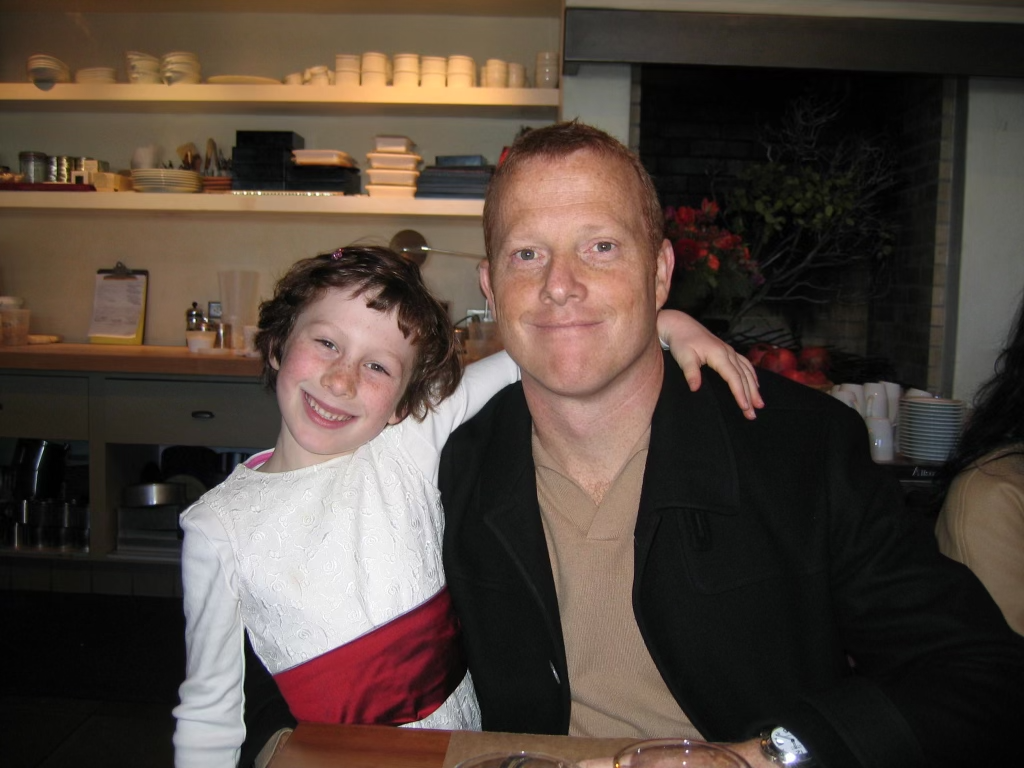
Us at another of my dad’s favorite restaurants in SF, circa 2005
First Meal
This story comes from my dad, a self-professed foodie, in all of its loaded connotations, and a San Franciscan for thirty years now, who has never lived anywhere but the Bay Area. The formative restaurant visit he mentions was at Zuni Cafe, a San Francisco institution, and the restaurant my parents claim they took me to straight from the hospital after I was born, though I have always been dubious of that account.
Spaghetti and Scallops
I did not expect my dad to provide me with such a perfect example of an authentically American concoction in the hotdog bun garlic bread he describes. Garlic bread is already a classically Italian American creation, loosely inspired by Italian bruschetta. While the hot dog bun is obviously not authentic, though arguably neither is garlic bread itself, ingenuity has always been a mark of the authentic. Authenticity is often the adaptation of existing formulas using ingredients and techniques that are available to you. Like my dad mentioned, “good bread” (and as someone who has insider knowledge into what my dad’s definition of good bread is, as Tartine and Acme’s revival of sourdough in the late 80s and 90s in San Francisco, it would not have even existed in San Jose in the 70s) was not available. While freshly grated parmesan and fresh garlic may have been available, they may not have been financially accessible to my grandma or afforded the same kind of convenience as Kraft parmesan and garlic salt.
I was struck by the legacy of the preparation of spaghetti in the US in the early 1900s, in my grandmother’s version some 70 years later: the overcooking of the pasta, the watered down version of garlic in the form of garlic salt, and the use of canned tomato sauce and ground beef. My dad talks too about his preference for pasta today, this freshly milled, freshly pulled version which would have been considered “foreign” and “dirty” in that same period of early introduction to pasta in the States, but has now become indicative of a kind of romanticisation of manual labor and peak-freshness that marks the upper class food culture of the Bay Area.
I was also struck by my dad’s perception of himself as naive, almost as though he had the wool pulled over his eyes, prior to his transformative restaurant experience in San Francisco, in that he was only capable of appreciating his mother’s cooking at the time because he had never known anything else. It is true that upon having more ressources, you may have access to a wider variety of dining experiences but my dad seems fixated on the idea that more resources necessarily translates to “better” food or food at a superior level as he suggests. My dad finds value in his mother’s ingenuity, in her providing him with nourishment, in sharing a meal with his family, though not in what he believes to be the quality of the food.
I am curious about how he describes this turn in interest in food, especially in the Bay Area, as a universal one. The evidence of the turn he is describing can actually be traced in part to Alice Waters, a pioneer of the “farm-to-table” movement and California cuisine, and the colleague of the chef at the restaurant he mentions. Another marker of this turn can be found in his description of his new experiences as involving a “purity of ingredients”. The elite food culture of the Bay Area, at least in the way that I’ve experienced it, could be described as a divorce from Countercuisine’s radical roots while preserving the emphasis on process, organic techniques, local and seasonal ingredients, innovation, and ethnic diversity.
Ultimately, I am extremely touched by the potential impact of loss on experiences of food. Perhaps our connection to food is heightened when we can no longer experience it in the same way, with the same people, the same ingredients, the same techniques, in the same space, in the same period of life. That my grandmother made my father his first meal and that he made her her last, evokes something incredibly heartbreaking and yet comforting, about the ways in which our relationships change with our parents as we all age. Our memories of food even become memorials.