Generic Story Title
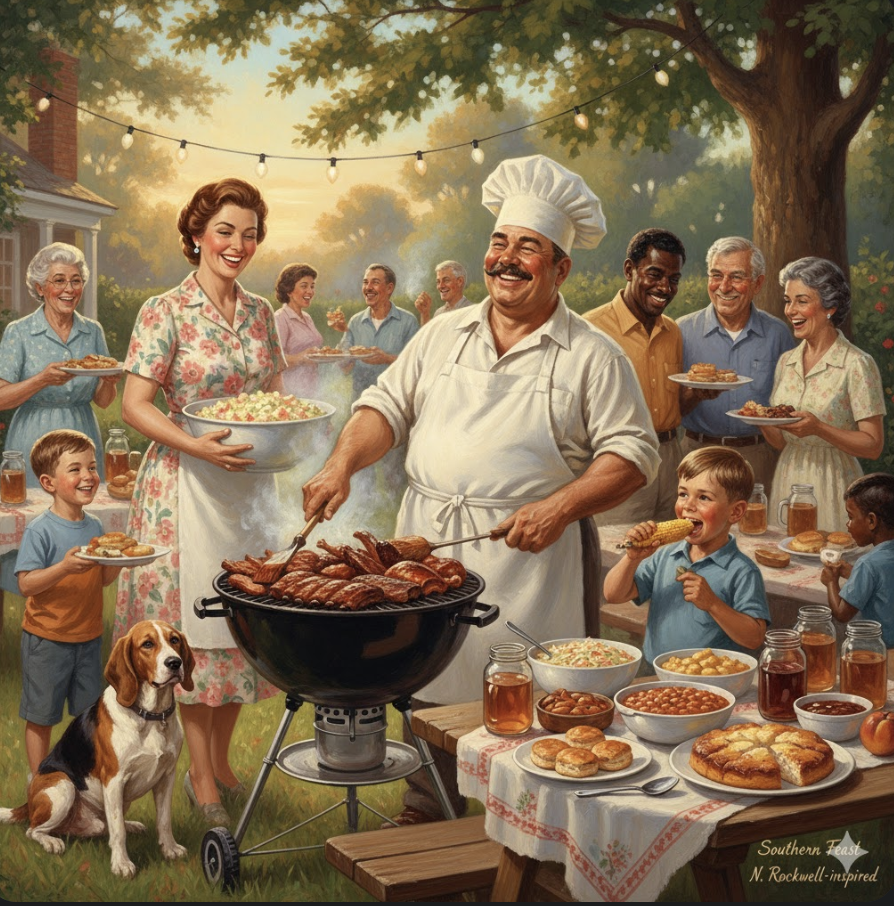
This story comes from Jordan Lee, who grew up in Chicago, where “barbecue” usually meant something you did on a gas grill in the backyard. She moved to North Carolina for school, and that’s where she got invited to her first real Southern barbecue.
What a nice view
Something more specific
She didn’t know it at the time, but that afternoon ended up changing the way she thought about food and history. A student recalls experiencing their first authentic Southern barbecue, where the smell of smoke, the sound of conversation, and the sense of community transformed a meal into something much deeper. They learn from the pitmaster about the tradition’s roots, passed down through generations and reflected in distinct regional sauce styles tied to Southern history. By the end, the student realizes that barbecue is not just food—it’s a living expression of history, family, and belonging.
Analysis: Smoke, Memory, and Belonging
Listening back to this oral history, what first stands out is how quickly the story moves from describing food to describing a feeling. The narrator begins with sensory detail — the smell of smoke, the chatter under the trees, the look of the smoker — but those descriptions quickly become about community rather than cuisine. That shift captures one of the big themes we’ve discussed in class: that food events are not just about eating but about sustaining relationships, passing on traditions, and affirming a sense of belonging. The barbecue becomes a living archive of memory and connection — something that exists through repetition and participation more than through written recipes.
The story also reflects the idea of embodied knowledge and generational transmission. The pitmaster’s line about learning from his grandfather and letting “the meat tell you when it’s ready” shows that expertise here isn’t formal or codified; it’s experiential and relational. In class, we’ve talked about how food work often relies on skills that are undervalued or unrecorded — the kinds of knowledge passed along by doing, by apprenticeship, by memory. In this sense, barbecue exemplifies what we might call vernacular expertise: a tradition maintained through labor, observation, and care, rather than through institutional authority.
When the narrator mentions the regional sauces — vinegar, mustard, tomato — and notes that each corresponds to a different part of the South, the story expands into a meditation on regional identity and historical layering. As we’ve read, those variations aren’t just matters of taste but markers of geography, migration, and cultural blending. The acknowledgment of Indigenous and African roots gestures toward the deeper and often erased histories embedded in “Southern” foodways. What feels like a casual backyard gathering is, on another level, the product of centuries of adaptation, exchange, and inequality.
Finally, the closing reflection — that the barbecue was “bigger than one meal” and “about belonging” — aligns with our discussions about food as cultural memory. The student recognizes that what endures isn’t just the recipe or the flavor, but the shared experience: the smoke, the labor, the crowd, the sense of continuity. In that moment, the story illustrates how oral histories capture what archives often miss — the ephemeral parts of culture that make history feel alive. Through sound, emotion, and storytelling, this single barbecue becomes a microhistory of American food itself: regional yet shared, ordinary yet full of meaning.